
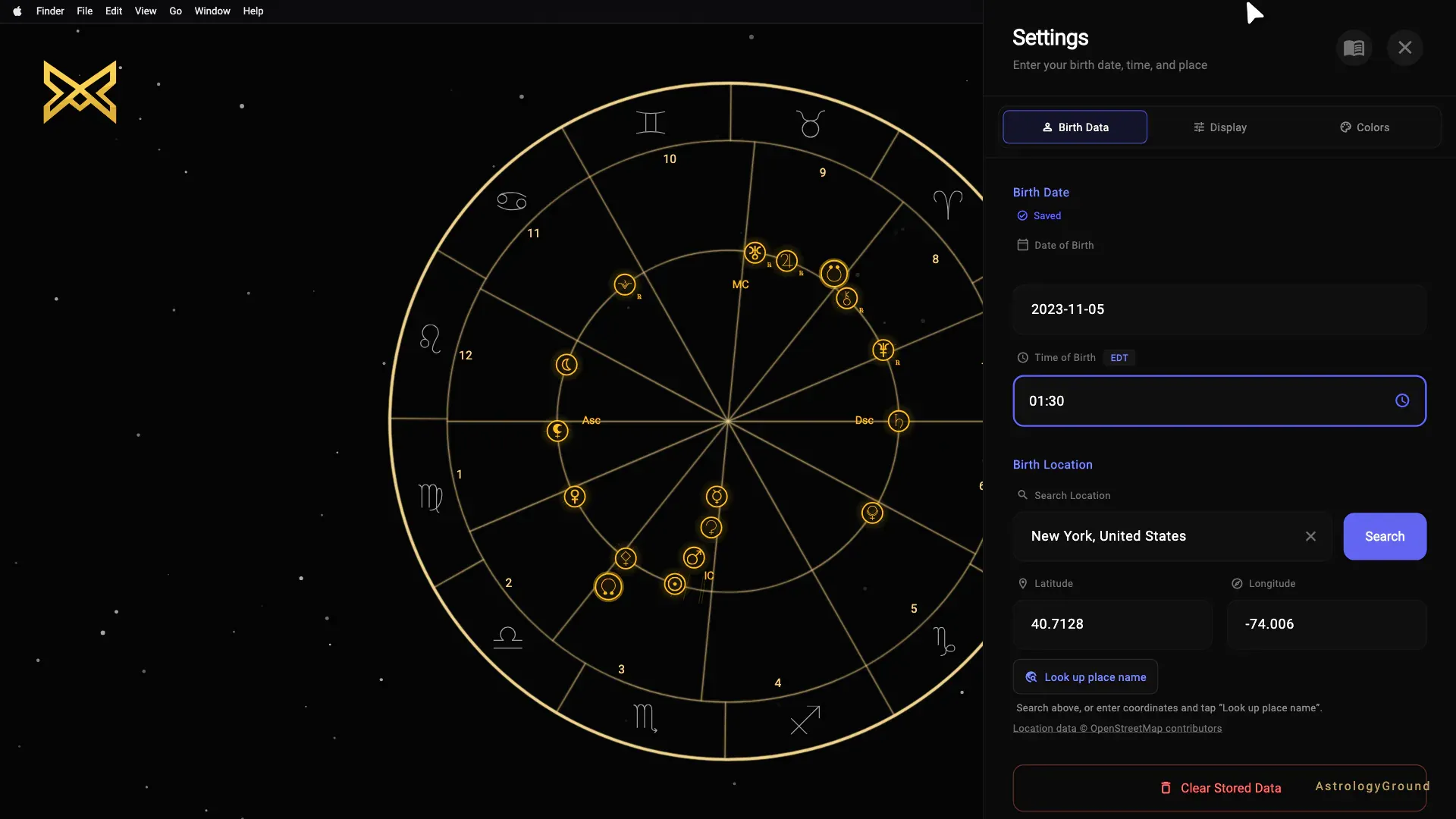
A birth record says 1:30 a.m. On the night clocks move back, 1:30 can happen twice. The same written time can point to two UTC instants and two chart calculations.
A natal chart calculator must resolve the local clock reading before it calculates the sky.
The calculation in one line
local birth date and time + birthplace time-zone rules → UTC instant → natal chart
The birthplace does two jobs. Its coordinates help calculate chart angles and houses. Its time-zone history tells the engine what the recorded clock time meant on that date.
A current UTC offset is not enough. The required offset can change with daylight-saving rules, legal changes, and historical local practice.
A time zone is more than an offset
UTC-05:00 describes one offset. America/New_York names a set of rules that can return different offsets on different dates.
At noon on January 1, 2000, New York used EST at UTC-05:00. Noon became 17:00 UTC.
At noon on July 1, 2000, it used EDT at UTC-04:00. Noon became 16:00 UTC.
The local clock says 12:00 in both cases. The historical rule selects the offset.
Abbreviations do not safely identify a zone. IANA notes that CST and IST each have several meanings. A location-based zone ID carries the rule history that a short label cannot.
Most local times have one answer
For an ordinary local time, the zone rules return one valid offset. The conversion is direct.
AstrologyGround derives a named time zone from the birthplace coordinates. It applies the rules for that zone and date, then converts the result to UTC for the ephemeris.
The app’s tests cover positive and negative offsets, half-hour offsets, seasonal daylight time, standard time, UTC, and named zones returned for real coordinates.
Some clock times never happened
When clocks move forward, the clock skips an interval. A local time inside that gap has no valid UTC offset.
In New York on March 12, 2023, the clock moved from 1:59:59 a.m. to 3:00 a.m. A recorded time of 2:30 a.m. did not occur under those zone rules.
The resolver used by the current AstrologyGround build normalizes that input to 3:30 a.m. EDT, or 07:30 UTC.
Converting the result back to local time returns 3:30, not the entered 2:30. Check the source record instead of treating the two clock readings as equivalent.
Some clock times happened twice
When clocks move back, part of the clock repeats. A local time inside that overlap has two valid offsets.
In New York on November 5, 2023, 1:30 a.m. occurred once in EDT and again in EST:
- 1:30 a.m. EDT was 05:30 UTC.
- 1:30 a.m. EST was 06:30 UTC.
The current AstrologyGround resolver selects the first occurrence for this case, 1:30 a.m. EDT. It does not ask which occurrence the birth record means.
One written time still leaves a one-hour uncertainty. The chart should preserve or show that uncertainty instead of pretending the source record chose an occurrence.
Ordinary, skipped, and repeated times
| Local-time case | Valid offsets | New York example | What the chart needs |
|---|---|---|---|
| Ordinary | 1 | July 1, 2000 at 12:00 | Use the single historical offset |
| Gap | 0 | March 12, 2023 at 02:30 | Check the record because that wall time did not occur |
| Overlap | 2 | November 5, 2023 at 01:30 | Choose the earlier or later occurrence |
The shift is not always one hour. It is not always caused by daylight-saving time. Zone rules can contain other legal offset changes.
What a careful chart workflow should record
For an ordinary time, store the local input, named zone, selected offset, and resolved UTC instant.
For a gap, flag the time and ask the user to check the record. Moving it forward silently creates a different clock reading.
For an overlap, show both offsets and ask which occurrence applies. If the record cannot answer, calculate both and label the uncertainty.
The time-zone database version also belongs in an auditable calculation record. Historical rules can be corrected after an app ships.
Historical data has limits
The IANA Time Zone Database is the practical source for civil-time rules, but IANA does not call it authoritative or error-free.
Its main design target is agreement from 1970 onward. It includes older transitions, but some early local histories are incomplete or modeled with local mean time.
For an old or disputed birth time, record the source and the assumption. A calculator cannot recover certainty that the historical record does not contain.
The IANA time-zone overview and IANA theory document explain those limits.
RFC 9557 defines the relationship between local time, offsets, zones, gaps, and overlaps.
The ephemeris starts after the app resolves civil time
The time-zone database answers a civil question: which offset applied at this place and local time?
The ephemeris answers an astronomical question: where were the supported bodies at the resulting instant?
Swiss Ephemeris accepts Universal Time or an explicit numeric offset. It does not infer a city’s historical rules from a birthplace name. The caller must resolve that step first.
AstrologyGround keeps the same separation. The birth-time resolver produces UTC. The native engine then calculates planetary positions, angles, and houses.
How to check a chart when the time may be wrong
- Copy the birth date and clock time exactly from the source.
- Check the birthplace, not the person’s current residence.
- Use a named zone for that place and date.
- Check whether the local time falls in a gap or overlap.
- Record the chosen offset and UTC instant.
- If the source cannot resolve an overlap, compare both charts and label both results.
Do not assume that a one-hour correction always changes the rising sign or moves every cusp by a fixed number of degrees. Calculate both instants and compare the results.
The guide to why birth time and location matter covers the basic inputs.
The natal chart calculation guide follows the full path from Birth Data to the rendered chart.
How AstrologyGround uses the result
AstrologyGround stores and processes Birth Data on the device for its core chart calculation. The computer’s current time zone does not replace the birthplace’s zone.
The resolver handles ordinary historical offsets and seasonal daylight changes. Regression tests also record its current gap and overlap behavior.
Read why Birth Data stays local for the storage and optional place-lookup boundary.