
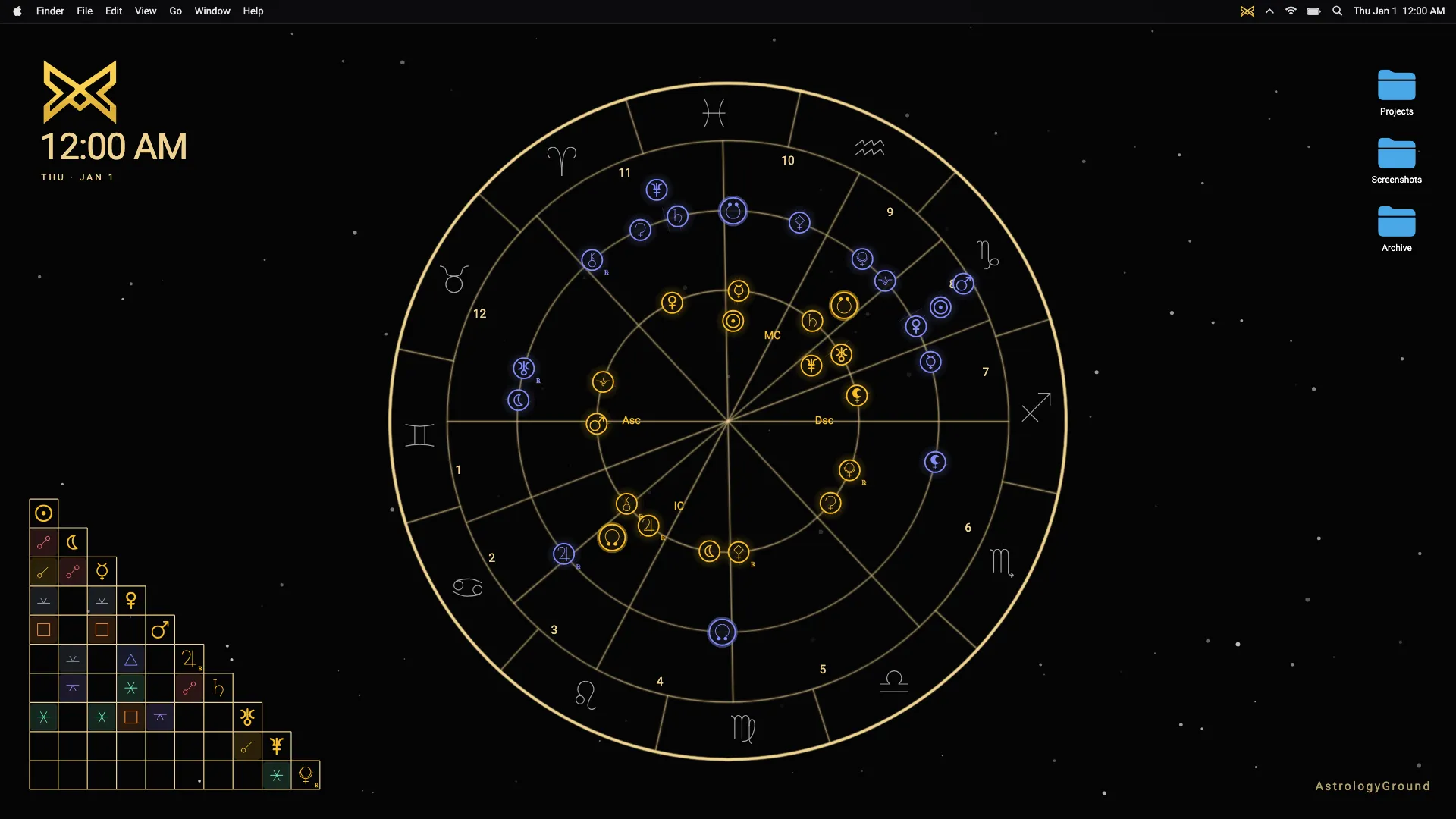
Birth time and location matter because a natal chart describes the sky at a particular moment from a particular place. The time identifies the moment. The birthplace supplies both the historical time zone needed to interpret the clock reading and the coordinates used for chart angles and houses.
For AstrologyGround, those inputs turn a broad birth-date description into a complete chart for its live astrology wallpaper.
A clock reading needs a place
“08:45” is not a single worldwide moment. It is a local time. Before the engine calculates planetary positions, AstrologyGround determines the time zone associated with the entered birthplace and birth date. It then converts the local reading to UTC for the ephemeris.
For a concrete example, 08:45 in Tokyo on January 1, 2000 corresponds to 23:45 UTC on December 31, 1999. The date changes when the moment is expressed in UTC, but the moment itself does not.
- Birth record08:45Tokyo · January 1, 2000
- Zone at that dateUTC+09:00Asia/Tokyo
- Engine input23:45 UTCDecember 31, 1999
Using the computer’s current time zone instead would make the result depend on where the person lives now. DagazLabs treats that as a correctness problem, not a cosmetic difference.
Coordinates shape angles and houses
Birthplace also provides latitude and longitude. The engine uses those coordinates with the birth instant to calculate chart angles such as the Ascendant and Midheaven, then constructs the houses according to the selected house system.
AstrologyGround supports Placidus, Whole Sign, Koch, and Equal houses. These systems do not move the planets to new positions. They divide or anchor the houses differently, so changing the setting can change the chart’s house structure.
This is why a birthplace is more than a label printed beside a chart. Its coordinates participate in the calculation.
Why an accurate time matters most for the chart frame
An approximate birth time can still give useful planetary positions for the date. It cannot promise reliable angles and houses.
The Ascendant follows Earth’s rotation and can move substantially over a few hours. House cusps move with the chart frame. The Moon can also change enough across a day for a rough time to matter, particularly near a sign boundary.
That does not mean every uncertain birth time is useless. It means the precision of the input should match the precision claimed for the result. AstrologyGround asks for a birth time because it builds and displays a complete natal chart, not just a Sun-sign image.
Historical time zones are part of accuracy
Time-zone offsets can differ by date, including daylight-saving rules. The same birthplace may use one offset in winter and another in summer. A modern fixed offset is not a safe substitute for the rule in effect at the entered birth date.
AstrologyGround resolves the birthplace’s time zone from coordinates and applies historical zone rules. That keeps the entered wall-clock time separate from the UTC instant the ephemeris needs.
As with any historical time calculation, the quality of the recorded time and the available zone history limit certainty. The app can calculate from the information supplied; it cannot recover a birth time that was never recorded accurately.
A useful way to check another chart
If two natal charts disagree, compare the inputs before assuming one engine is wrong:
- Are the birth date and local clock time the same?
- Did both tools use the birthplace’s time zone for that date?
- Are the latitude and longitude for the intended birthplace?
- Are they using the same house system?
Those checks often explain why the Ascendant or houses differ while planetary positions remain close. For the rest of the calculation path, read how a natal chart is calculated.
Why this data stays local
Birth date, time, and location are personal inputs. AstrologyGround stores and processes them on the device for core chart calculation. The optional place-name lookup is separate and does not send the birth date or birth time with the query.
Read why birth data stays local and the formal Privacy Policy for the exact app and website boundaries. For the next calculation step, see how live transits are calculated.