
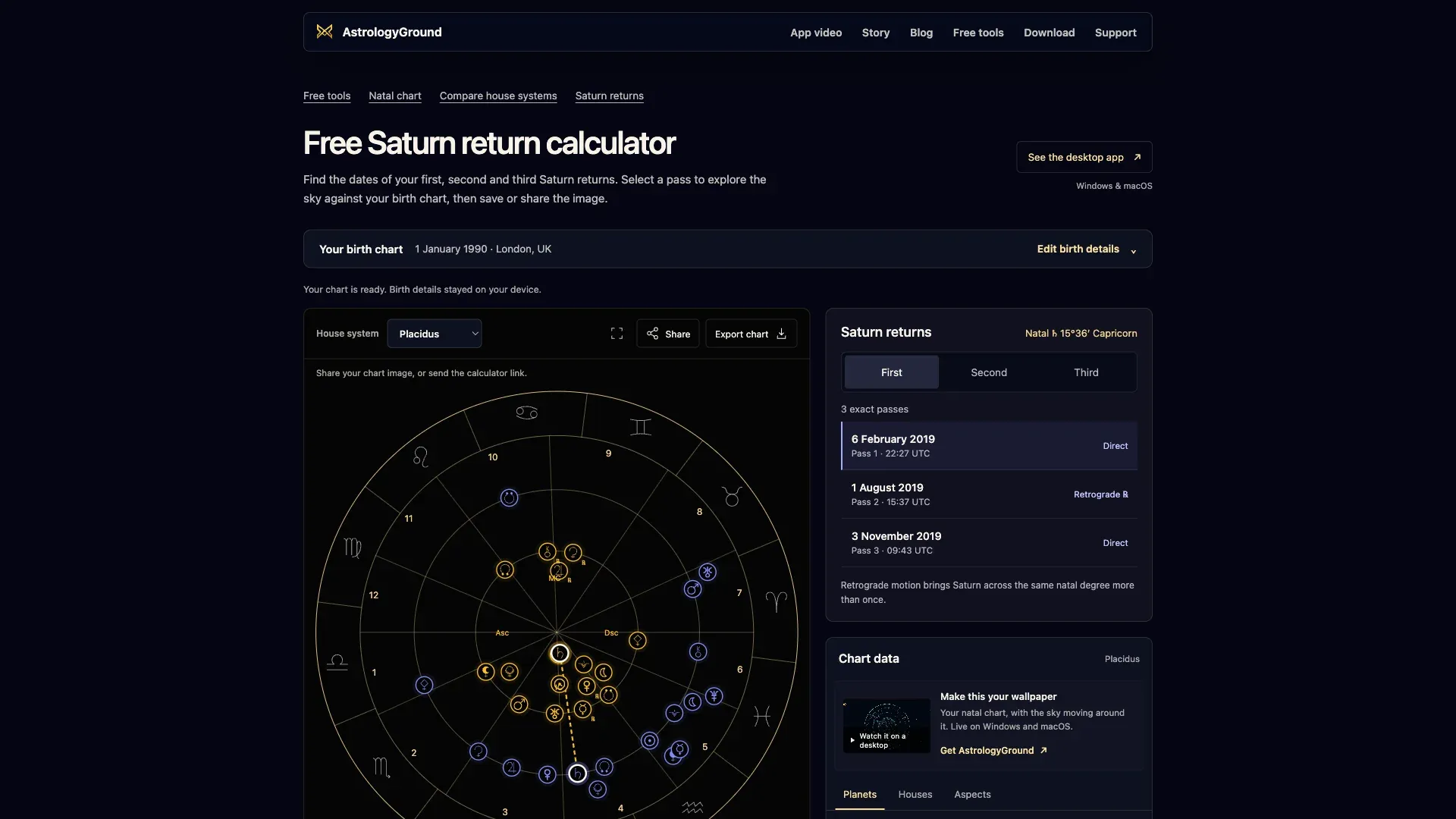
A Saturn return happens when Saturn in the sky reaches the zodiac position it occupied when you were born. The first usually arrives around age 28–30, with later returns in your late fifties and late eighties. The exact date depends on your natal Saturn’s degree, and retrograde motion can bring more than one crossing within the same return.
You can find those crossings with our free Saturn return calculator. If the result gives you several dates, they belong to the same cycle.
What does a Saturn return mean in astrology?
In astrology, Saturn is associated with responsibility, limits and the structures that support a life. CHANI’s guide to Saturn returns describes the return through themes of accountability and maturity. That is the symbolic context behind discussions of commitments, work and growing older.
You can use those themes to reflect on a commitment you’re making, a responsibility you’ve taken on, or a limit you need to recognise. For example, looking back at a long project might help you see which demands were chosen and which you accepted without much thought.
A calculated conjunction cannot tell you that a relationship must end, that you must change jobs, or that a difficult year is inevitable. We use the chart to make the timing visible; interpreting what a period means calls for your own context.
At what age does a Saturn return happen?
NASA gives Saturn’s orbital period as about 29.4 Earth years. That helps explain the spacing between returns. In their discussion of Saturn returns, astrologers Leisa Schaim and Chris Brennan give the first around 28–30, the second around 57–60, and the third in the mid-to-late eighties.
These ages are a guide. A personal return compares Saturn’s position as seen from Earth with its position at birth. Its apparent motion includes pauses and retrograde loops, so adding 29.4 years to your birth date will not reliably find the exact conjunction.
Your Sun sign alone cannot give you that date either. The target is your natal Saturn’s position. Two people with the same Sun sign can have different Saturn return dates.
Why one Saturn return can have three exact dates
Retrograde motion means a planet appears to move backwards against the background sky. For outer planets such as Saturn, this happens as the faster-moving Earth overtakes them. NASA’s explanation of Saturn’s retrograde motion describes that change in perspective.
From our viewpoint, Saturn can pass a natal degree going forward, move back across it, then pass it again going forward. Those are three contacts within one return. Some returns have a single exact pass.
A worked example you can reproduce
We entered an illustrative birth chart for 1 January 1990 at 00:00 in London, UK, using the Europe/London time zone. This is a teaching example, not a person’s account of their life. Natal Saturn displays at 15°36′ Capricorn. The calculator lists these first-return passes, with times in UTC:
- 6 February 2019 at 22:27: direct.
- 1 August 2019 at 15:37: retrograde.
- 3 November 2019 at 09:43: direct.
All three dates fall in 2019, when the example chart’s owner would be 29. The first and last are about nine months apart. The August crossing is the middle pass of the first return; the second Saturn return comes decades later.
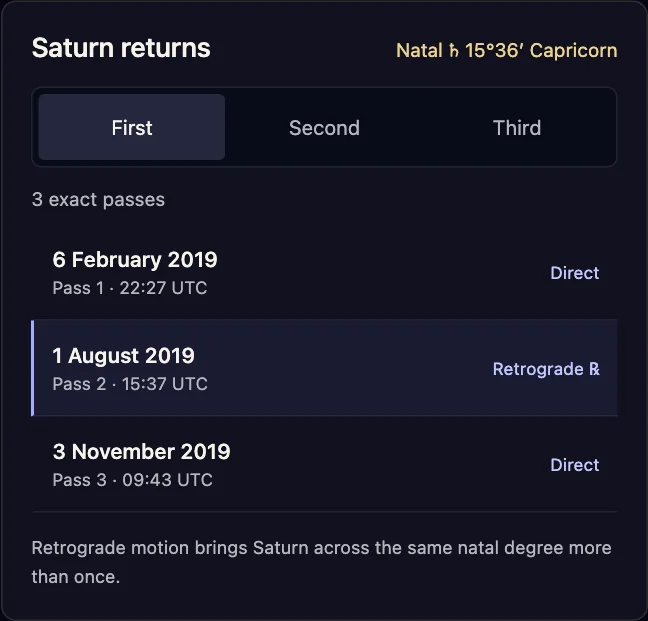
The displayed natal degree is rounded to the nearest arcminute; the search uses the underlying longitude. These times come from our tropical, geocentric calculator. Another ephemeris can differ by a few minutes, particularly near a station, where Saturn appears to pause before changing direction.
How long does a Saturn return last?
An exact conjunction is a moment. If there are several passes, the interval between the first and last describes the span of those contacts. In our example, that span runs from February to November 2019.
Astrologers may mean a broader period when they discuss “your Saturn return”. For example, CHANI defines that period by Saturn’s passage through its natal sign. Other approaches use an orb: an allowed angular distance from the exact conjunction. Our guide to aspects and orbs explains that measurement.
When comparing dates, check which definition you’re reading. The calculator lists exact contacts. It does not assign a universal start or end to an experience, and the nine-month span in the example does not define every Saturn return.
Find and explore your own Saturn return
Enter your birth date, recorded local birth time and birthplace in the calculator. Choose First, Second or Third, then select a pass. Your natal planets appear in amber. The sky at the return appears in indigo. You can show either layer on its own or compare them.
If you’re new to comparing charts, our guide to live transits explains the relationship between a fixed birth chart and the moving sky. A Saturn return is one particular transit: Saturn forming a conjunction with natal Saturn.
Keep your birth time’s accuracy in mind. An uncertain time also makes the exact return time uncertain, especially near a station. Houses and angles are more sensitive to the birth time. You can still explore a chart with an approximate time, but treat those details accordingly. See why birth time and location matter.
The calculator shows transits against your natal houses. It does not cast a separate set of return houses for your current location. It searches through 2099 and labels returns outside that range as unavailable.
Birth details and calculations stay in your browser. If you want to keep a result, save or share a chart image. Birth details stay off the image unless you choose to add them. The tool privacy details explain the difference between local calculation, website analytics and a file you choose to share.
Find your Saturn return dates, then select a contact to see where Saturn meets its natal position on your chart.