
October moves quickly when you stop looking at it one day at a time. The Moon sweeps around the wheel while the outer planets barely seem to move.
AstrologyGround compresses the full month into 62 seconds. You can watch the chart gather, stretch, and redraw itself without turning the geometry into a forecast.
One month in 62 seconds
The video starts at 00:00 UTC on October 1 and ends at 00:00 UTC on November 1. Every second of playback advances the sky by 12 hours.
Only the current sky is visible. We hid the natal planets, houses, natal aspects, and cross-aspects. The clock and transit aspect grid stay on screen, using the same layout as the wallpaper app.
The renderer uses a fixed capture profile to orient the zodiac wheel. It does not use reader data, and no personal natal chart appears in the footage.
What to watch as the sky moves
Start with the Moon. It covers more of the wheel in a few seconds than the outer planets cover during the entire video.
Then watch the aspect lines. They appear, tighten, and fade as pairs of positions move into and out of the configured orb for each aspect.
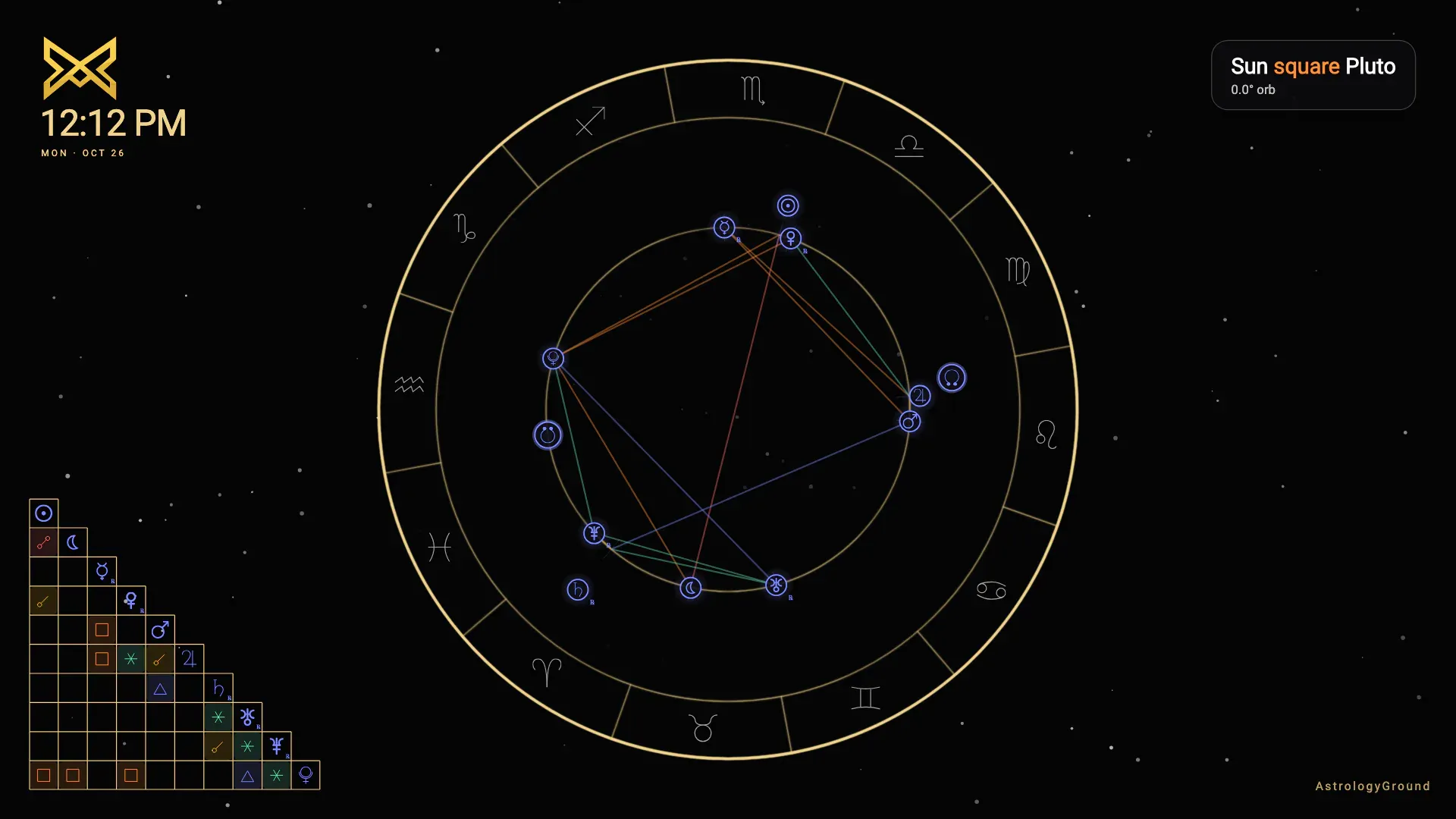
The callout in the upper-right names the closest major aspect. Its highlighted aspect word uses the same color as the matching line and grid symbol. The grid in the lower-left gives you the wider set of transit-to-transit relationships at that moment.
Finally, look past the busiest part of the chart. The slower bodies hold the wider structure while the faster ones keep rearranging the pattern.
Five moments worth pausing
We found these five stops in AstrologyGround’s October track. Each one catches a clear conjunction, square, or trine without assigning it a prediction.
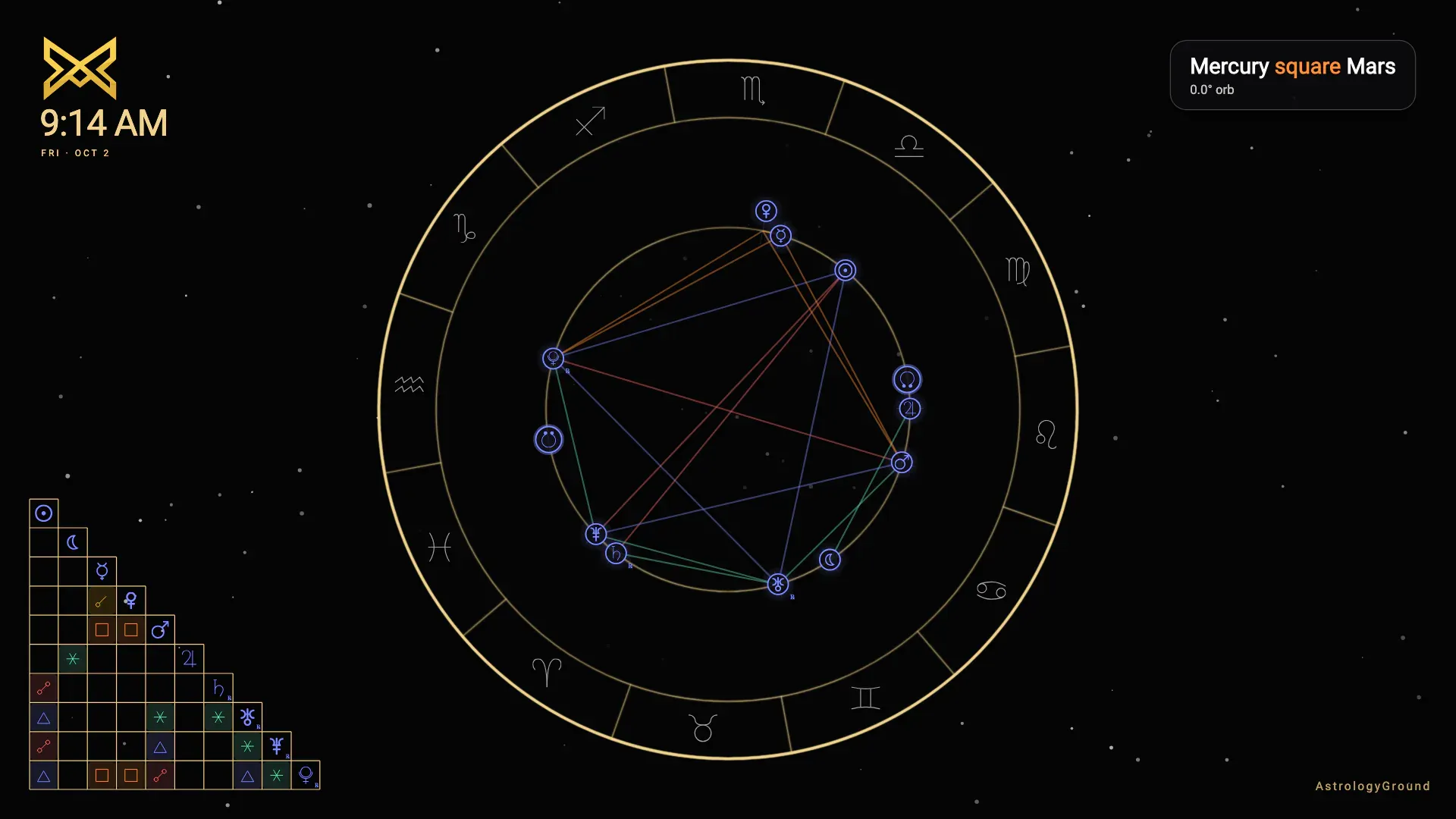
October 2: Mercury square Mars
At about 09:14 UTC, Mercury and Mars come nearest a 90-degree separation. Their square stretches across the wheel instead of bringing the two markers together.
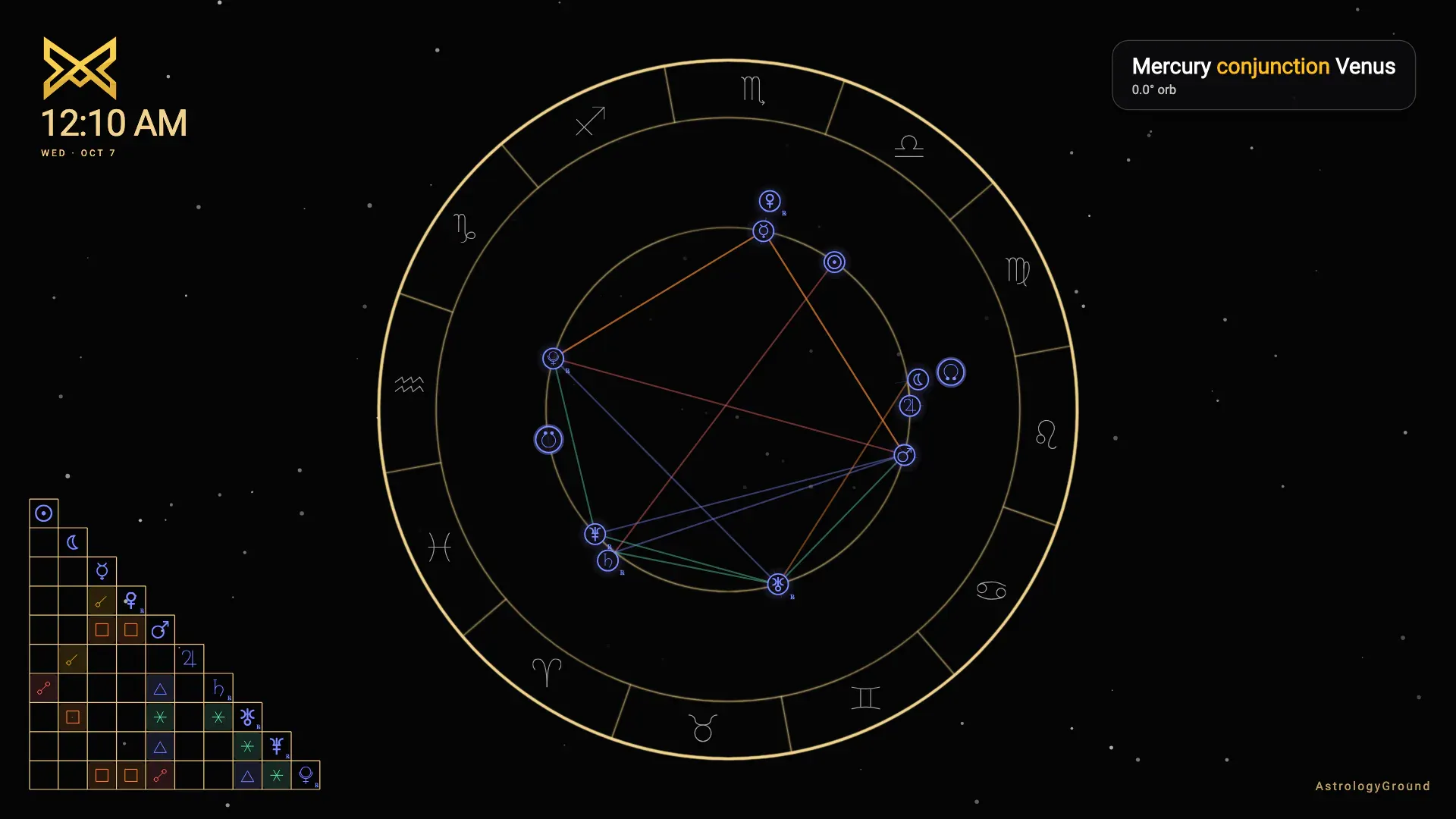
October 7: Mercury conjunct Venus
At about 00:10 UTC, Mercury closes in on Venus. A conjunction targets 0 degrees, so the markers gather in one part of the wheel instead of spanning it.
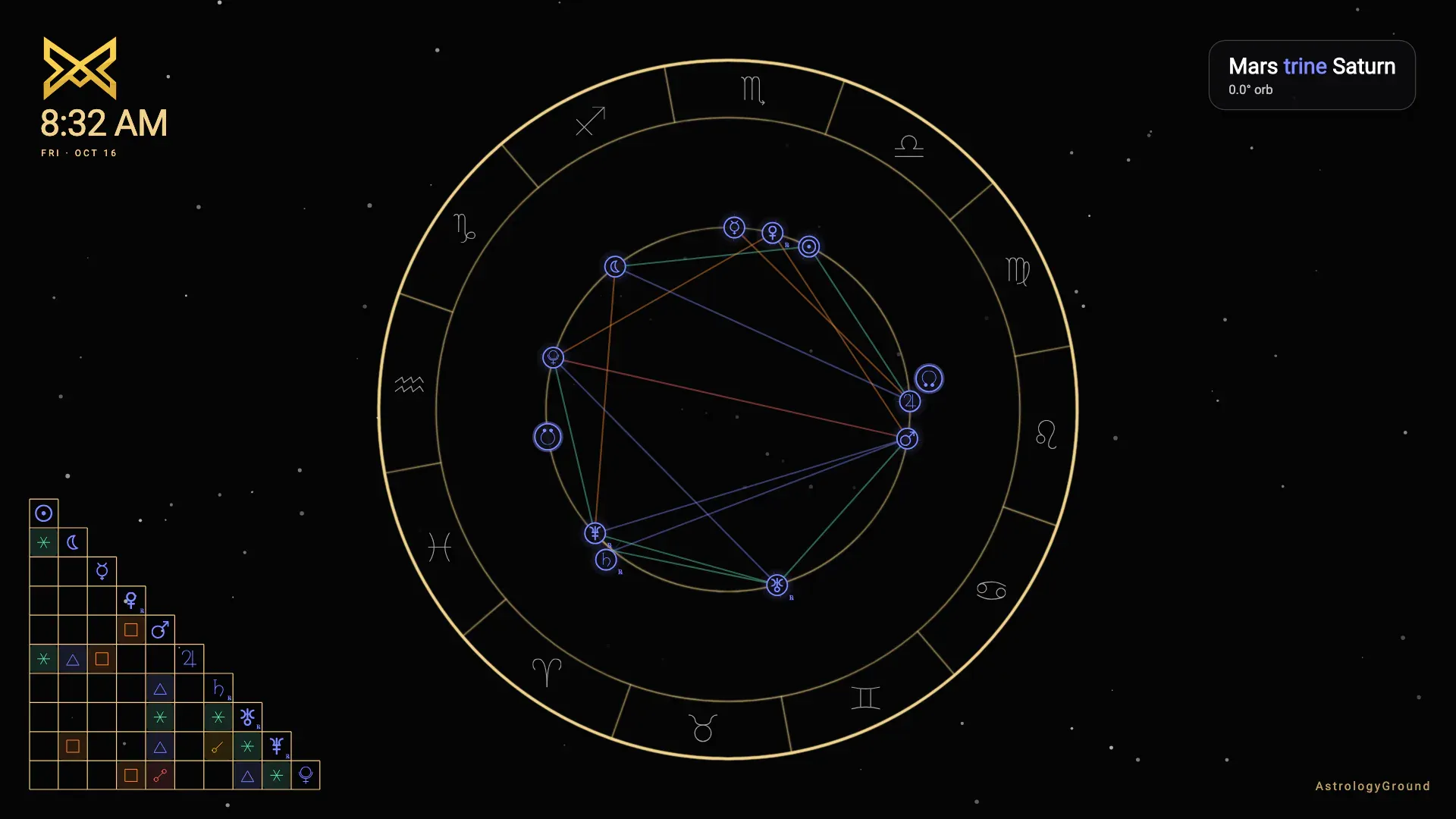
October 16: Mars trine Saturn
At about 08:32 UTC, Mars and Saturn sit nearest a 120-degree separation. The trine keeps both markers distinct while connecting them across a broad part of the chart.
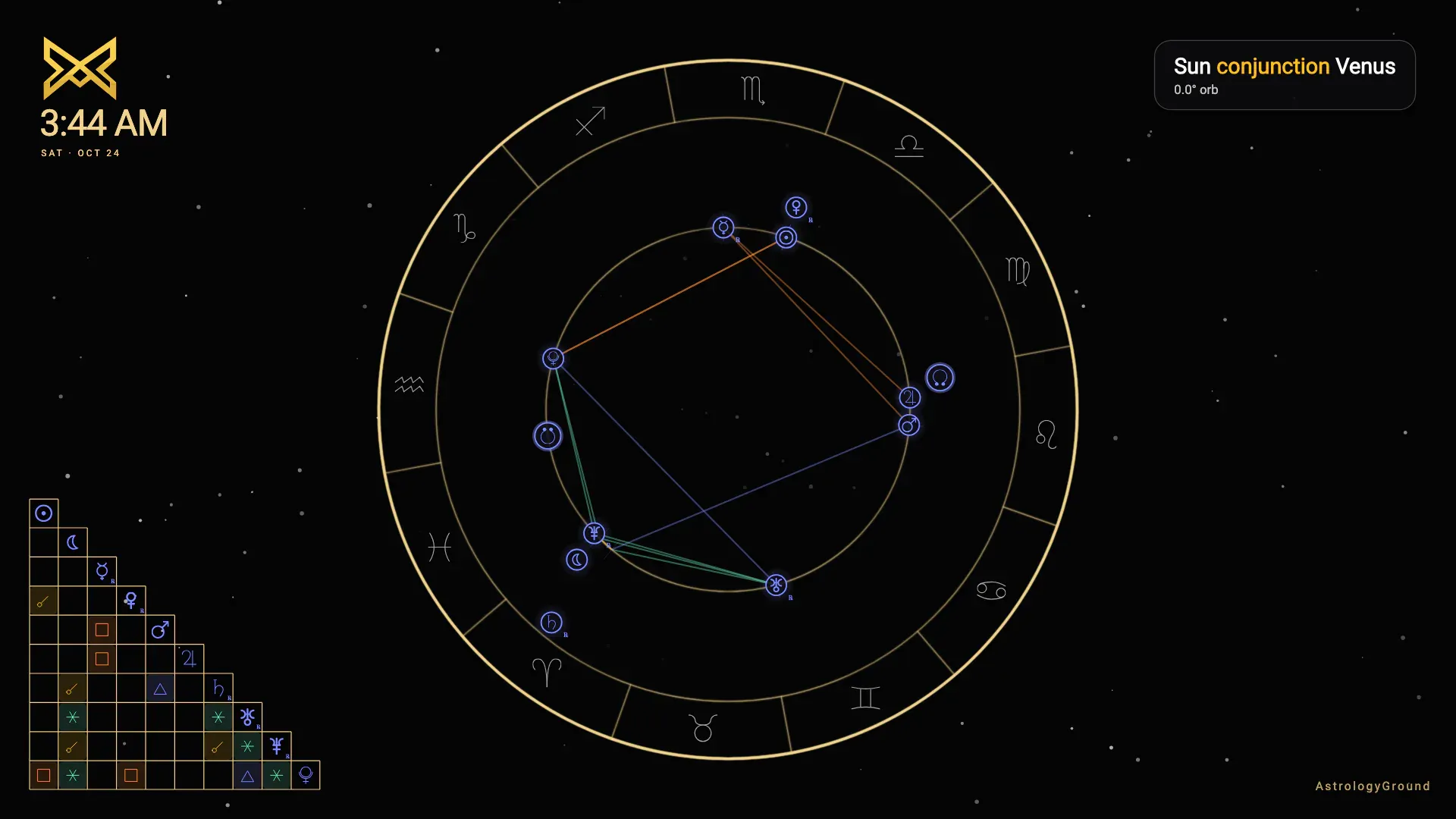
October 24: Sun conjunct Venus
At about 03:44 UTC, Venus reaches its closest sampled conjunction with the Sun. It repeats the 0-degree geometry from October 7 with a different pair and position.
October 26: Sun square Pluto
At about 12:12 UTC, the Sun and Pluto come nearest a 90-degree separation. The square returns near the end of our sequence with a different pair of bodies.
How we chose the five moments
The engine sampled October every three hours. We used that first pass to find promising changes, then checked each candidate at one-minute intervals.
The times above mark the nearest one-minute sample to each aspect’s exact target angle. They come from the same engine and settings used for the video.
How to read the lines
AstrologyGround starts with the calculated longitude of each shown body. It measures the shortest distance between each pair, then checks that distance against the supported aspect angles and orbs.
The guide to astrology aspect calculations explains the angles and orb check. The live transit guide follows the path from a timestamp to the wheel.
Limits of this view
The five stops describe geometry at stated UTC times. They offer no October forecast, advice, or reading of a personal natal chart.
A normal AstrologyGround wallpaper can place the current sky around a fixed natal chart. This video hides that personal layer so you can follow the current sky on its own.
For more context, read what live transits are or compare the fixed natal chart with the changing transit sky.
Watch October move
The video keeps the full 62-second month without interrupting the chart. It is hosted on YouTube, and the website loads the privacy-enhanced player only after you press play.
Watch the October video on YouTube. For the next month, see November’s sky recording.